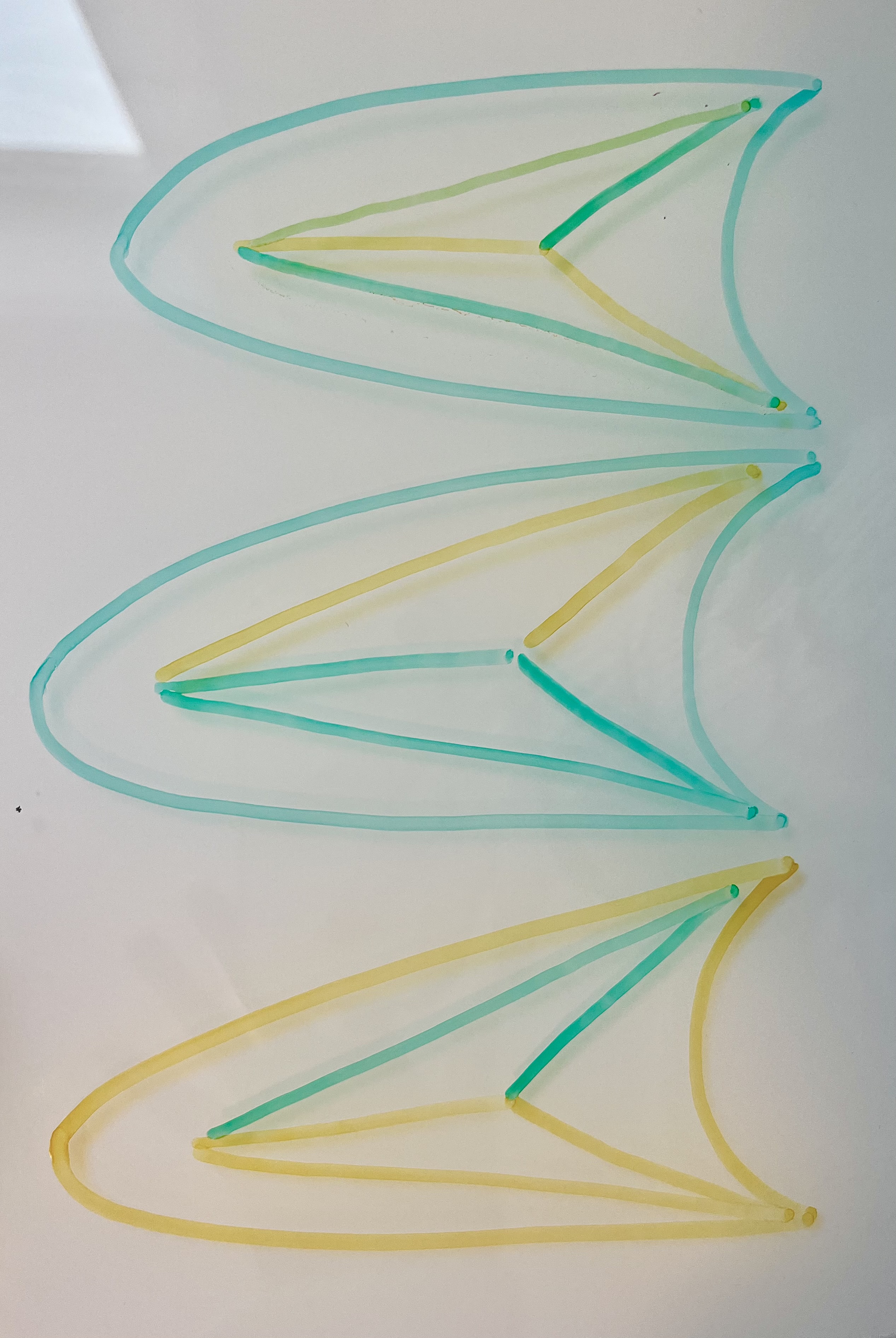
This work explores the dismantling of Coast Salish design elements through a process of deliberate fragmentation and reconstruction. Traditional visual design elements, structures, crecents, U-shapes, and flowing linear shapes—are taken apart and reassembled, shifting their original coherence into a field of experimentation. Rather than presenting fully resolved forms, the composition invites the viewer’s eye to complete the missing connections, allowing perception itself to participate in the rebuilding of meaning.
Lines are interrupted, staggered, and dispersed so that rhythm replaces continuity. In this disruption, negative space becomes active, holding tension between what is visible and what is implied. The viewer is asked to “finish” the design mentally, engaging with the work as a living visual system rather than a fixed image.
Layers of pigment are overlaid in translucent and opaque washes, allowing hues to merge optically rather than remain static. New colours emerge through overlap—shifting tones that exist only in relation to one another. This layering echoes natural processes of sediment, tide, and light, where meaning accumulates through repetition and variation.

Dismantling and Taking Coast Salish Design Apart.
I like to see the simplicity of each line of Coast Salish designs. I find it fascinating to take each element of our designs apart and layer them back together where each layer relies on the one below it to create the fill design. Working together to create one element of the design so it can become a whole.


Dismantling and Reconnecting Design
This design process is an opportunity to slow down, observe, and understand the relationships held within each line, form, and element. By carefully dismantling a design into three separate layers using different colours and materials, we are invited to look more deeply at how each part contributes to the whole.
Each layer represents its own story, movement, and connection. When separated, the individual lines and forms become visible, allowing us to recognize the intention, balance, and teachings held within the design. Just as in our natural world, where every being, plant, animal, waterway, and element has its own role and relationship, each part of the design carries importance and purpose.
The process of rebuilding the design through three interconnected layers reflects the Coast Salish understanding that everything exists in relationship. No single line or element stands alone; the beauty and strength of the design comes from how each part supports and connects with the others. Through layering, we learn that individual pieces contribute to a greater whole, creating balance, harmony, and continuity.

Adding Shading and Texture
The Raven Stole the Sun is a painting that I did using texture, metallic paint, shading and gold leaf. To tell the legend of the raven who stole the sun.
Shapes and Things
Taking design apart and putting it back together gives me a more in depth understanding of the different elements and how they rely on each other to create a whole